
5 AI Tools Replacing Middle Management in 2026
Robert Half’s 2024 Outlook confirms that AI is no longer a speculative upgrade but a structural replacement for mid-level oversight. This roundup evaluates specific platforms capable of automating performance tracking, resource allocation, and compliance reporting with enterprise-grade precision.
-
Asana for automated task routing
Asana’s AI engine assigns work based on capacity and skill, removing the need for managers to manually delegate. It predicts bottlenecks before they stall projects, ensuring resources align with deadlines. This automation reduces the administrative burden on team leads, allowing them to focus on strategy rather than tracking individual task statuses or chasing updates across spreadsheets. -
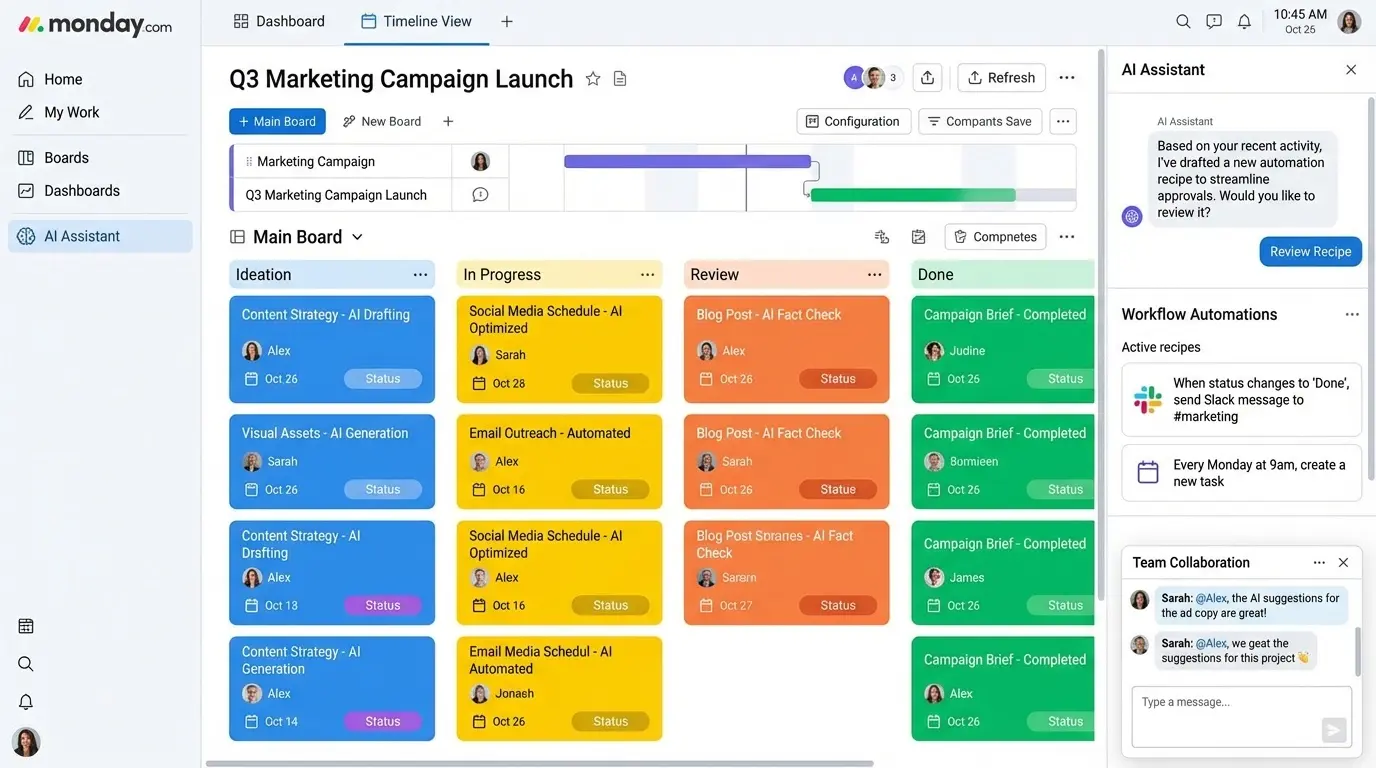
Monday.com for workflow automation
Monday.com replaces manual status checks with self-running workflows that trigger actions based on real-time data. When a milestone is hit, the system automatically notifies stakeholders or updates related fields without human intervention. This eliminates the middle manager’s role as a status reporter, ensuring that project visibility is maintained through automated logic rather than manual oversight. -

Notion AI for knowledge management
Notion AI transforms static wikis into searchable, dynamic knowledge bases that answer employee queries instantly. It summarizes lengthy documents and retrieves specific policy details, reducing the need for managers to act as information gatekeepers. By centralizing institutional memory, it ensures teams access accurate data without waiting for managerial approval or clarification on standard procedures. -

ClickUp for performance tracking
ClickUp provides granular performance metrics by analyzing time tracking and goal completion rates automatically. It generates objective performance reports, removing the subjective bias often present in managerial reviews. This data-driven approach allows leaders to identify high performers and training needs directly from the platform, streamlining the evaluation process and reducing the time spent on manual performance assessments. -

Slack AI for communication filtering
Slack AI filters noise by summarizing long threads and highlighting actionable items within busy channels. It reduces the need for managers to monitor every conversation for critical updates, ensuring that important decisions are not lost in the chatter. This tool empowers employees to prioritize relevant information independently, decreasing reliance on managerial intervention for communication triage and decision-making clarity.
The Shift from Oversight to Automation
The structure of the modern office is undergoing a quiet but decisive overhaul. While public discourse often fixates on the return-to-office mandates, the reality for distributed teams is far more pragmatic. According to Robert Half’s Q1 2026 data, 77% of new job postings are fully on-site, with only 4% offering fully remote options. This sharp decline in remote availability signals a broader contraction in the flexibility that defined the previous decade.
For the remaining workforce operating outside traditional headquarters, the burden of coordination has shifted. As Forbes notes, 2026 trends point toward a human-centric approach that must coexist with AI domination. In this environment, middle management roles that once served primarily as communication bridges are being streamlined. The oversight layer is not disappearing; it is being automated.
Callout: With 77% of new job postings fully on-site (Robert Half), remote efficiency tools are critical for the segment still working from home.
This transition is not about replacing leadership with algorithms. It is about removing the administrative friction that slows down decision-making. AI tools are now capable of tracking progress, flagging bottlenecks, and synthesizing reports—tasks that previously required a dedicated manager to oversee. The result is a leaner operational model where human oversight focuses on strategy rather than status updates.
Remote work ai tool: what to check next
The shift toward distributed teams is no longer a temporary adjustment; it is the baseline. According to recent data from SurveyMonkey, 15% of workers are now fully remote, while 10% operate in hybrid setups. This structural change forces companies to replace traditional middle management oversight with automated tracking systems.
The following questions address the practical implications of these tools in a 2026 context, focusing on retention and operational reality rather than hype.

As an Amazon Associate, we may earn from qualifying purchases.
No comments yet. Be the first to share your thoughts!